Building elements of BESD® technology
BESD® technology is an innovative industrial utility model that produces ad hoc building components through a standardized technological system.
All the elements of BESD® work together in solidarity to achieve optimal performance in terms of mechanical resistance, energy performance and environmental performance.
Organic and eco-efficient, healthy and indestructible. A safe and lasting investment that appreciates over time.
Structure
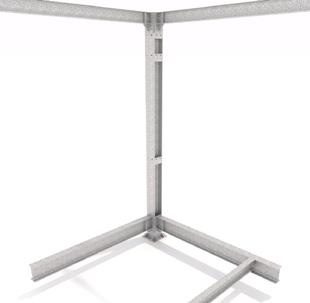
The BESD® technology structural system uses standard S355 JR steel profiles, such as HE, IPE, UPN, commercial C-sections, and flat profiles.
The elements are specially treated, and all processes follow the BESD® technology specifications.
Their thickness is never less than 4 mm.
Floor panel
Structure:
- completely dry assembled;
- tray made of galvanized steel frame (6 mm thick) and Hi-bond type corrugated sheet metal (Concrete version) or fibre/wood sheet;
- collaborating reinforcement welded orthogonally to the direction of the ribs (Concrete version);
- package stratification: medium-high density insulation and/or loose natural aggregate, lightweight conglomerate with volcanic aggregates and hydraulic lime mortar (Concrete version) and/or double fibre/wood slab, dry screed.
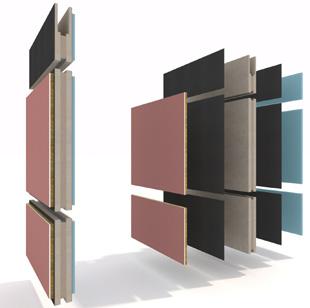
Wall panel
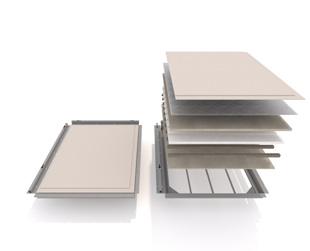
Structure:
- completely dry assembled;
- steel endoskeleton designed to perform connection functions between adjacent elements and with the load-bearing structure.
Type:
- composed of 3 or more bands (depending on the height between floors) of standard, interlocking elements that make up the perimeter wall, produced based on the openings provided in the wall and complete with vertical and horizontal structural connection systems.
Integrated system provisions (on request):
- electrical system cable routes (backbone and distribution);
- provision of collectors for the water-sanitary and/or heating system.
The BESD® system allows for the creation of cutting-edge building envelopes suitable for all climate zones, including those subject to high daily temperature variations.
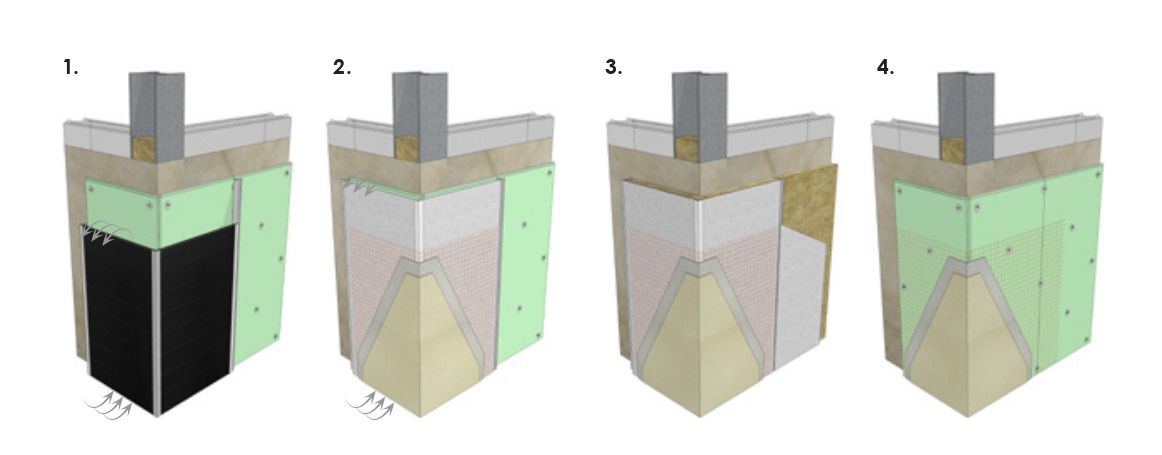
The ventilated envelope (images 1 and 2), suitable for tall buildings, can be constructed with opaque panels of various materials, shapes, and colors, as well as with POLYSUNPV® photovoltaic panels, which make the building highly energy efficient.
The non-ventilated envelope (images 3 and 4), on the other hand, consists of an external insulation system, made with high-density insulating panels positioned close to the BESD® wall.
Each type of envelope can be finished with a skirting and sidewalk, complete with a ventilation system and rainwater drainage channel.